
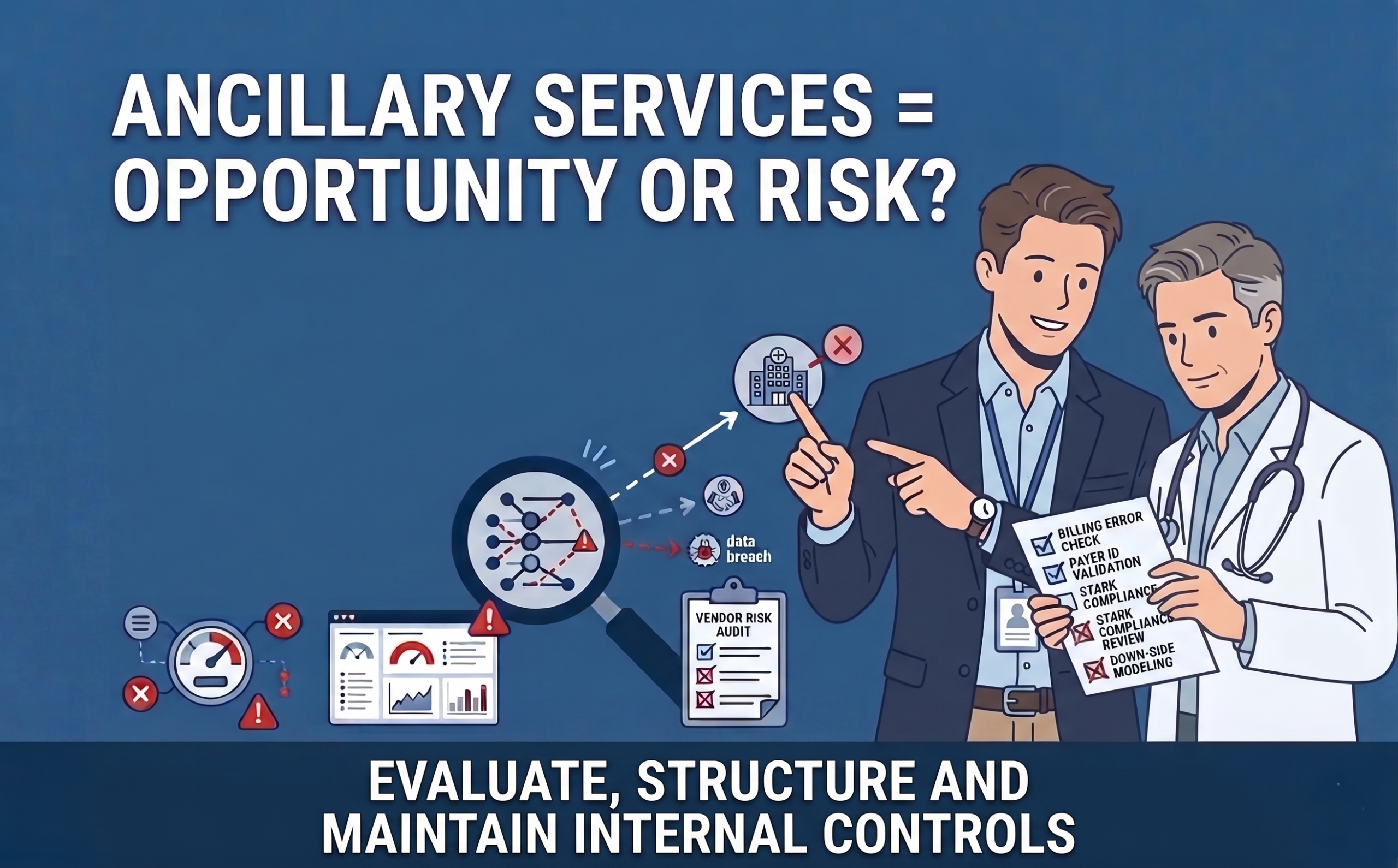
How incentive mismatches, clearinghouse vulnerabilities, and compliance traps quietly undermine your practice’s bottom line.
Ancillary services—remote patient monitoring (RPM), in-office diagnostics, advanced imaging—offer a legitimate, often underutilized revenue stream. With reimbursement pressure mounting on primary care, diversifying your revenue mix makes strategic sense. The risk isn’t in the services themselves. It’s in the vendor landscape that’s grown up around them.
Because ancillary services require specialized technology, credentialing, and billing expertise, most practices rely on third-party vendors—most of whom mean well. But the economic incentives baked into how they sell can quietly create structural vulnerabilities in your revenue cycle. This guide helps you spot those vulnerabilities before you sign, and manage them if you’re already live.
The Incentive Mismatch You Need to See
Commissions on “bolt-on” service lines are often 2–3x higher than on standard service contracts—creating a structural incentive for account executives to prioritize rapid onboarding over careful integration. This isn’t about bad actors. When a vendor’s success metric is contracts signed, the downstream consequences—billing errors, clearinghouse disruptions, documentation gaps—land on your practice. Not theirs.
The value of an ancillary program should be measured not by how quickly it goes live, but by how cleanly it runs six months in.“Volume tells you how busy you are. Yield tells you how valuable that business actually is.
Your Clearinghouse: The Most Vulnerable Point
Your medical billing clearinghouse standardizes claims into HIPAA-compliant EDI formats (like the 837P) and routes them to payers. It’s also the most common failure point when an ancillary vendor integration goes wrong.
The failure mode is rarely dramatic. A vendor requests login credentials or asks to update your Payer ID settings—a change that seems minor. But a single misconfigured EDI link or incorrectly entered Tax ID can cause your primary claims to stop routing, often without an immediate error message. Data floats in a processing void, payments stop, and because the failure is silent at first, you may not notice until you’re 30 days into a revenue gap.
Key principle: No ancillary vendor should require administrative access to your clearinghouse. If they do, that access must be logged, time-limited, and supervised by your billing team.
The 14–30 Day Validation Window
When vendors update banking or ACH information in payer portals during setup, they trigger a standard pre-note validation process—typically 14–30 days—before payers release payments to the new account. For a new ancillary program that’s manageable. But if the change inadvertently affects your primary payment routing, you could face a complete freeze on incoming revenue for up to a month.
Protection is simple: require dual approval for any changes to banking information or Tax IDs, with no exceptions for vendor-assisted setup.
Regulatory Exposure: Stark & Anti-Kickback Statute
Vendors routinely call their arrangements “fully compliant.” Many are. But the legal landscape is nuanced enough that you should scrutinize, not accept.
• Stark Law is strict liability—intent doesn’t matter. If an in-office lab fails the “75% rule” for Group Practices, consequences include mandatory refunds and civil penalties up to $24,947 per violation. No cure period. No good-faith defense.
• Anti-Kickback Statute (AKS) is criminal. A violation can occur if even one purpose of a payment arrangement was to influence referrals. Safe Harbors exist, but require precise structuring.
Before signing: have compliance counsel review the specific structure—not just the vendor’s boilerplate. Ask the vendor which Safe Harbor applies and document their answer. If they can’t answer clearly, that’s material information.
Case Study: Why RPM Programs Often Underperform
Remote Patient Monitoring is one of the most marketed ancillary opportunities in primary care—and one of the most commonly mismanaged. The reimbursement model is sound; the operational reality is harder. Industry data suggests 20–30% of RPM claims face delays or denials, most often due to documentation gaps and failure to meet the 16-day data-capture requirement under CPT 99454. Without deep EHR integration, this compliance burden falls on already-stretched clinical staff, generating administrative friction without proportionate revenue.
When vendor software fees are fixed and patient engagement underperforms, a program modeled at 80% participation may deliver half that—turning a projected revenue line into a net cost.
Before launching RPM, model the downside: 40% patient engagement, 25% denial rate. If the program is still financially viable, proceed. If not, negotiate different fee terms or walk away.
Evaluate every ancillary vendor against these criteria before signing. We have developed a quick reference Guide for Vendor Evaluations as vendors come to your office all the time and you do not have time. Not only we included “What to Ask”, “Red Flags”, we also included the “Internal Control” column identifies the safeguard your practice should have in place regardless of vendor. If you are interested in obtaining a copy of this reference guide, please drop us a request by submitting a contact form with subject line: Ancillary Service.
The Bottom Line
Ancillary services can contribute meaningfully to practice revenue. The practices that benefit most aren’t the fastest movers—they’re the ones that evaluate carefully, structure clearly, and maintain internal controls throughout the relationship.
The goal isn’t to avoid ancillary services. It’s to make sure they add to your practice—not complicate it.
Embrace opportunities with eyes open.
If you’re evaluating an ancillary vendor—or already live with one and want a second opinion on how the arrangement is structured—our team is available to review your setup and identify any revenue cycle exposure.
Book a Free Audit Call with us and we can help you to minimize risks in your growth path based on your own data, not just being dazzled by the sales people’s promises.